Call analysis
Car dealership BDC: scoring every inbound sales call
A car dealership BDC can score every inbound call, not a small sample. See what to check on each call and what a score cannot tell you.

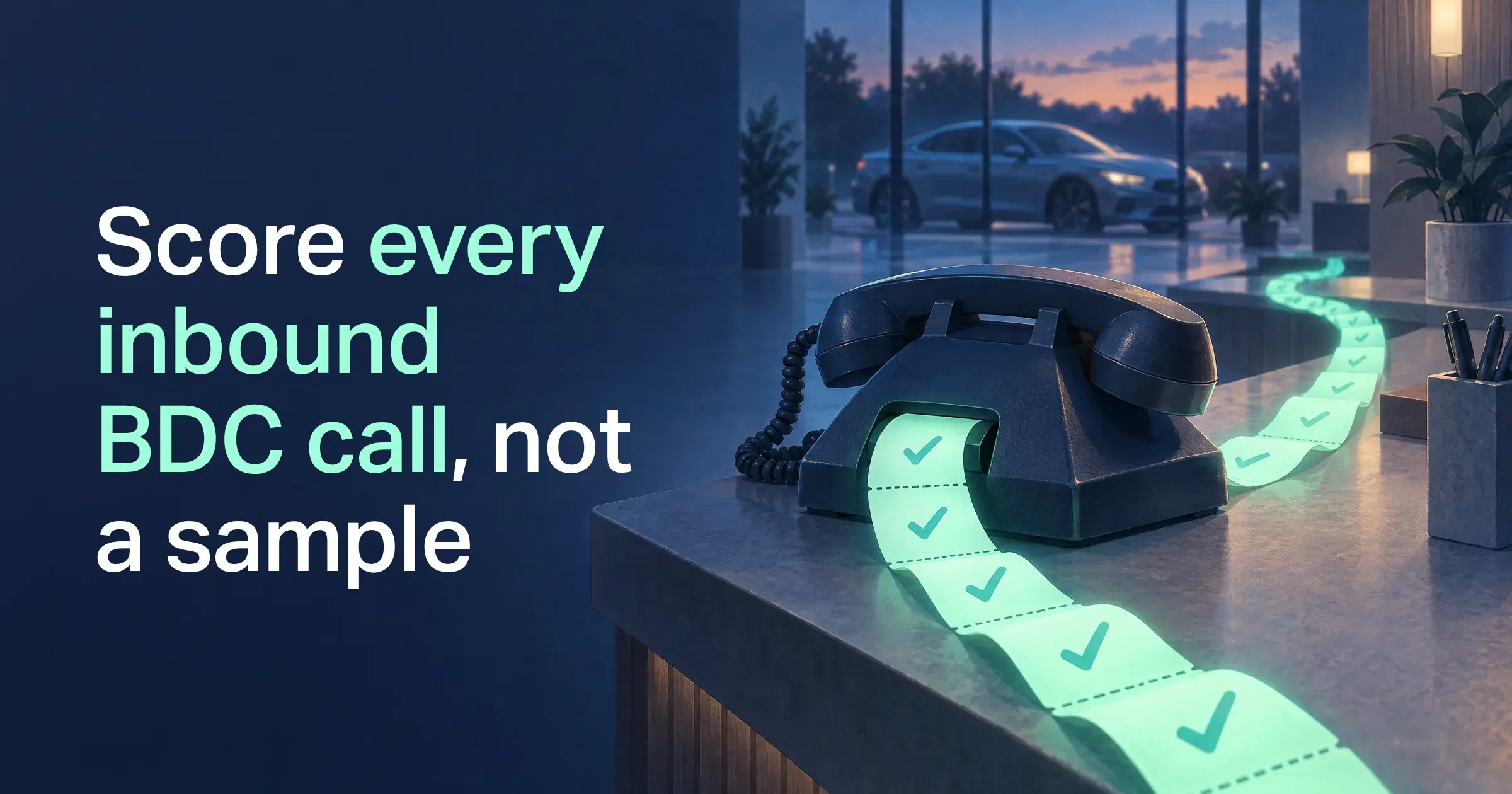
A car dealership BDC (business development center) can score every inbound call instead of a small sample. Every call gets the same set of questions, such as whether the rep found out what the caller wanted, and whether an appointment was offered. Every score links to the words said on the call.
A caller who does not get an appointment may never complain. They may call the next number on the list, and the recording may be the only record of what happened.
Key takeaways
- A car dealership BDC can score every inbound call instead of a small sample, with each score linked to the words said on the call.
- A sampled score usually covers the calls that are easy to pick, so missed appointments can sit in the calls nobody scores.
- Start with five plain questions: the reason for the call, contact details, the next step, answers given and follow-up.
- A score shows what was said on the call, not why a caller went elsewhere, so use it to point coaching at the right moment.
What does a car dealership BDC do on the phone?
A BDC is the dealership team that answers inbound calls and online leads and books appointments. For some customers, the call is the first thing they hear from the dealership.
Reps give pricing, scheduling and vehicle information, and check financing basics. A manager usually cannot listen to all of them, so some calls are never heard by anyone but the rep.
Why does a sampled call score miss the calls that matter?
A call quality score is usually taken from a sample of calls, scored by a manager or reviewer. A sample can only be as good as the calls picked for it, and reviewers often pull the calls that are easy to find, such as calls that were flagged or complained about. The calls in between often go unscored.
That is where missed appointments can sit. A customer who asks a question, gets a vague answer and hangs up may never complain. A rep whose average looks fine can still lose the same kind of call again and again, and a sample may not show it.
Our page on manual call sampling goes deeper on sampling versus reading every call. It is written for Australian financial services licensees (businesses that hold a financial services licence).
What should you check on every inbound BDC call?
Keep the list short, and make each check a question anyone on the team can answer by reading the call. A good starting scorecard:
| Check | The question | Why it matters |
|---|---|---|
| Reason for the call | Did the rep find out what the caller wanted? | Answering the wrong question can waste the call |
| Contact details | Did the rep get a name and a phone number? | Without them, follow-up can be harder |
| Next step | Was an appointment or visit offered, and did the caller agree? | Booking the visit is usually the goal of the call |
| Answers given | Did the rep give a clear answer on price, stock or financing, or guess? | A wrong promise can turn into a complaint |
| Follow-up | Did the rep promise a callback, and say when? | A callback that never comes can cost the sale |
Here is an example, made up for illustration: a caller asks whether a used SUV is in stock, and the rep says yes and quotes a price but never asks for a phone number or offers a visit. That call finds out what the caller wanted and gives a clear answer, but it misses the contact details and the next step. The caller did not complain, yet a visit that never happened is easy to miss.
Write each check in plain words, try it by hand on a few calls, and change it until two people score the same call the same way. A check that two people read differently may not be ready to run on every call.
How do you score a call without arguing about what was said?
Metricsense reads every call your team takes and scores both sides: what the customer asked for, and how the rep handled it, including process, clarity, empathy and how the call was resolved. Every score opens the exact moment in the transcript that produced it, so a coaching conversation can start from what was actually said.
Your team describes how it judges a call. Metricsense builds the checks from that description, and your team confirms the results match its own judgment. The checks are plain English, so anyone can read what they look for.
Metricsense raises a flag when it finds a possible problem on a call, with the exact words attached. One of your people decides what it is, and nothing is acted on automatically. You can read more on the page about call transcript analysis.
What can a BDC call score not tell you?
A score is built from what was said on the call, so it only covers calls you record. It does not show why the caller chose another dealership, or what happened after they hung up. Use it to point a coaching conversation at the right moment.
Check your local rules before you record or review calls. Some state laws restrict recording phone calls. California's Penal Code section 632 is one example: it covers recording a confidential phone call without the consent of everyone on it, and it applies to businesses.
The Federal Communications Commission (FCC) consumer guide also points you to your state for the answer. It was last reviewed in 2019, so confirm with your state.
How do you try this on your own calls?
Start with a small batch. A pilot reads around 50 of your calls and gives you a readout inside a week. Bring the five checks above to start.